Motor control circuit simulator

Wire it. Run it. Break it.
Let an agent drive it.

VoltLab simulates electromechanical motor-control circuits — DOL starters, interlocks, reversing starters, a 10-story relay elevator, an electric vehicle drive — with a real per-tick electrical solver and IEC-style schematics. Drive them like machines: accelerator & brake pedals, a VFD with frequency ramps, e-stop mushrooms, car operating panels. And because it speaks MCP, an LLM agent can build, wire, fault and document every circuit for you.
CI License: MIT Release Node ≥ 18 MCP server
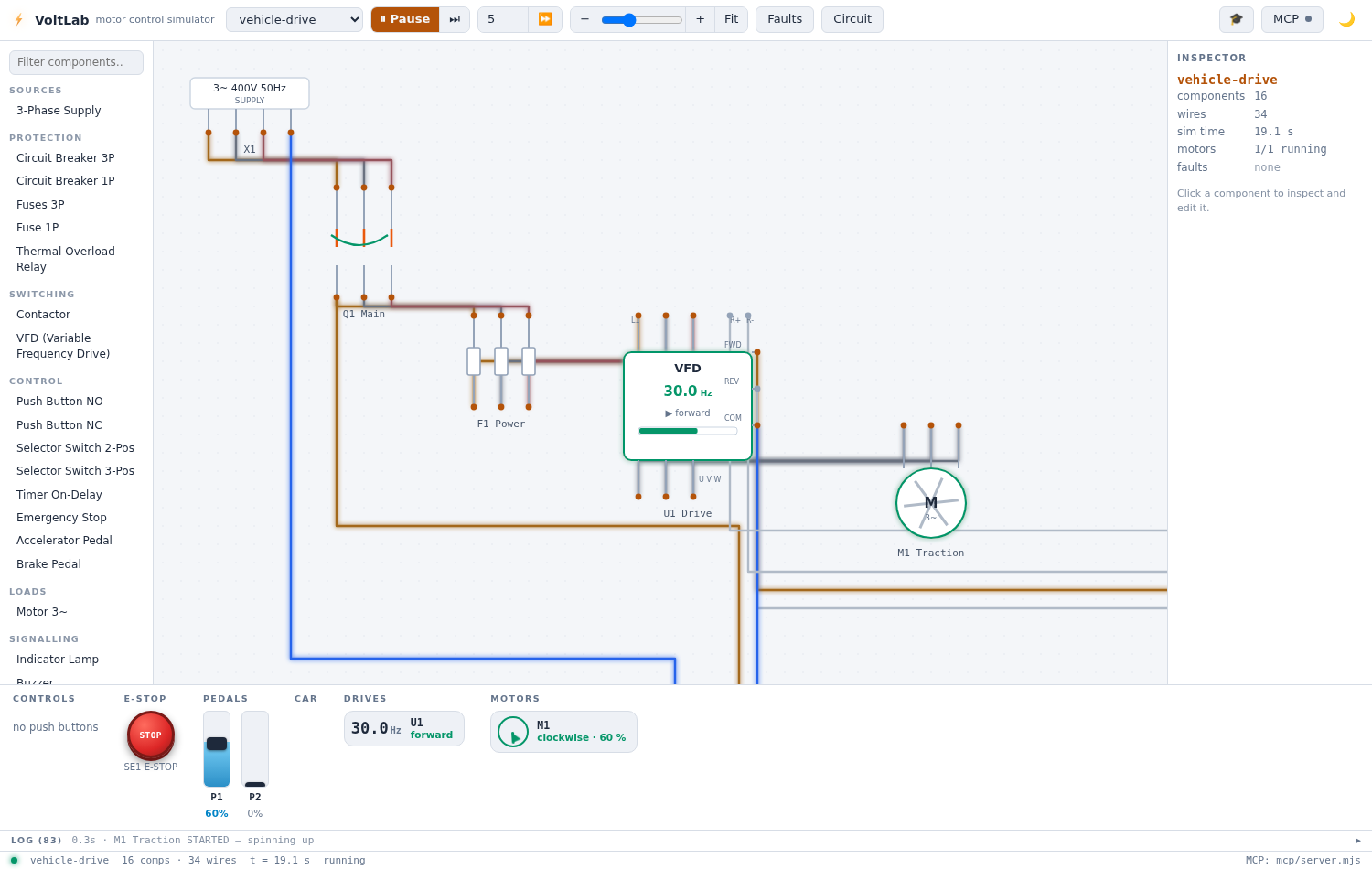
VoltLab driving an electric vehicle circuit: accelerator pedal, VFD readout and traction motor in the operator console
No install, no backend

This is the real simulator

Not a video, not a mock-up: the page below runs the actual sim/engine.js solver in your browser — the same code the desktop app and the MCP agents drive.

Try: hold S1 on the schematic — the contactor picks up and the motor spins (release: the seal-in keeps it running). Toggle breaker Q1 by clicking it. Pick reversing-starter and watch the interlock. When the thermal overload KK1 trips (⏩ 5s after a stall), click its red RESET. New in v1.3: load vehicle-drive and drag the accelerator pedal in the console — or slam the e-stop and watch the drive ramp down; take elevator-cop for a ride from its car operating panel.

Why VoltLab

A trainer bench, a drawing office and an agent playground

🔌Real physics

Per-tick union-find netlists and phase propagation: 6× FLC inrush, class-10 thermal trip curves, single-phasing, coast-down, fuse blowing — plus VFDs with synthesized rotating fields, frequency ramps and phase-sequence motor direction.

🕹Operator console

The bottom panel grows real controls for whatever the circuit contains: drag-able accelerator/brake pedals, a twist-release e-stop mushroom, drive Hz + direction readouts, a 7-segment floor indicator and car-call grids.

📐IEC-style schematics

23 device types drawn as proper IEC symbols, phase-colored live wires, terminal-level wiring, zoom from 25–300 %, inspector and event log.

🤖MCP agent layer

29 tools over stdio JSON-RPC (or plain HTTP): agents build, wire, fault, reset, fast-forward, drive pedals and call floors — the full test suite is an agent session.

📄Self-documenting exports

Any circuit exports as an IEC 61082-1-style multi-sheet PDF drawing set (zone grids, title blocks, sheet index) and a scripted 720p demo video.

📱Desktop, Android, offline

Signed installers for Windows, macOS and Linux plus an Android APK with the full offline editor — or zero-install right in this browser. Server, simulator and MCP bridge are pure Node stdlib.

New in v1.3 — the operator round

Drive it like a machine

Seven new electrical devices — a variable frequency drive, accelerator and brake pedals, an e-stop mushroom, a 3-position selector, a car-call panel and a floor indicator — turn schematics into things you operate. Nothing here is decoration: the pedal is a potentiometer feeding the VFD's analog reference, the brake's NC contact cuts the drive enable while its mechanical side drags the motor, and car calls latch through real relay logic.

Electric vehicle drive with the operator console: accelerator pedal dragged high, VFD readout, traction motor spinning
vehicle-drive: drag the accelerator and the pedal's analog output ramps the VFD toward its reference — the traction motor follows the synthesized rotating field, direction and all.
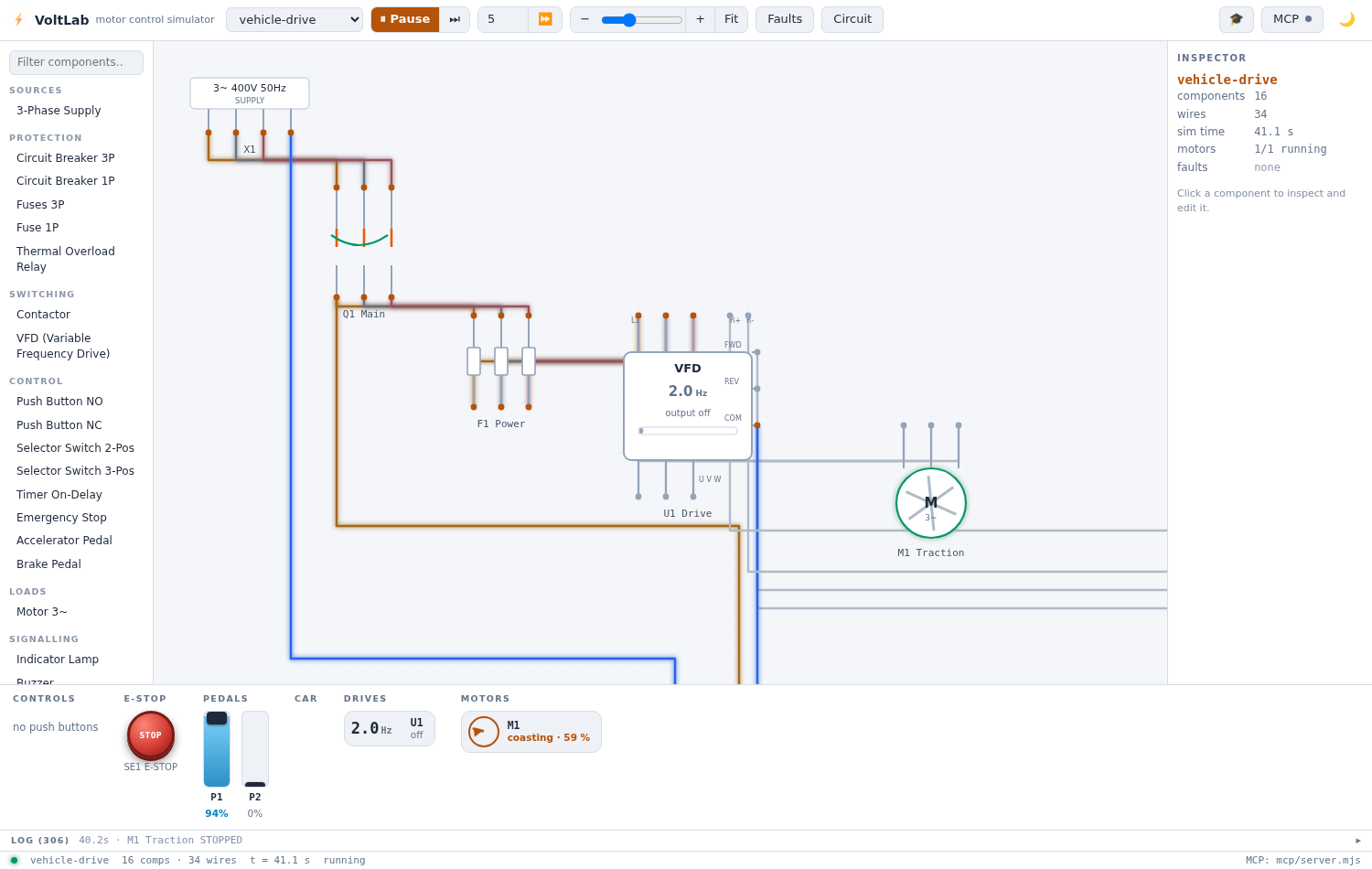
The same vehicle drive after the e-stop: frequency ramping down, motor coasting
Slam the e-stop: the drive's enable path opens, the frequency ramps down and the motor coasts — the brake lamps tell you why.
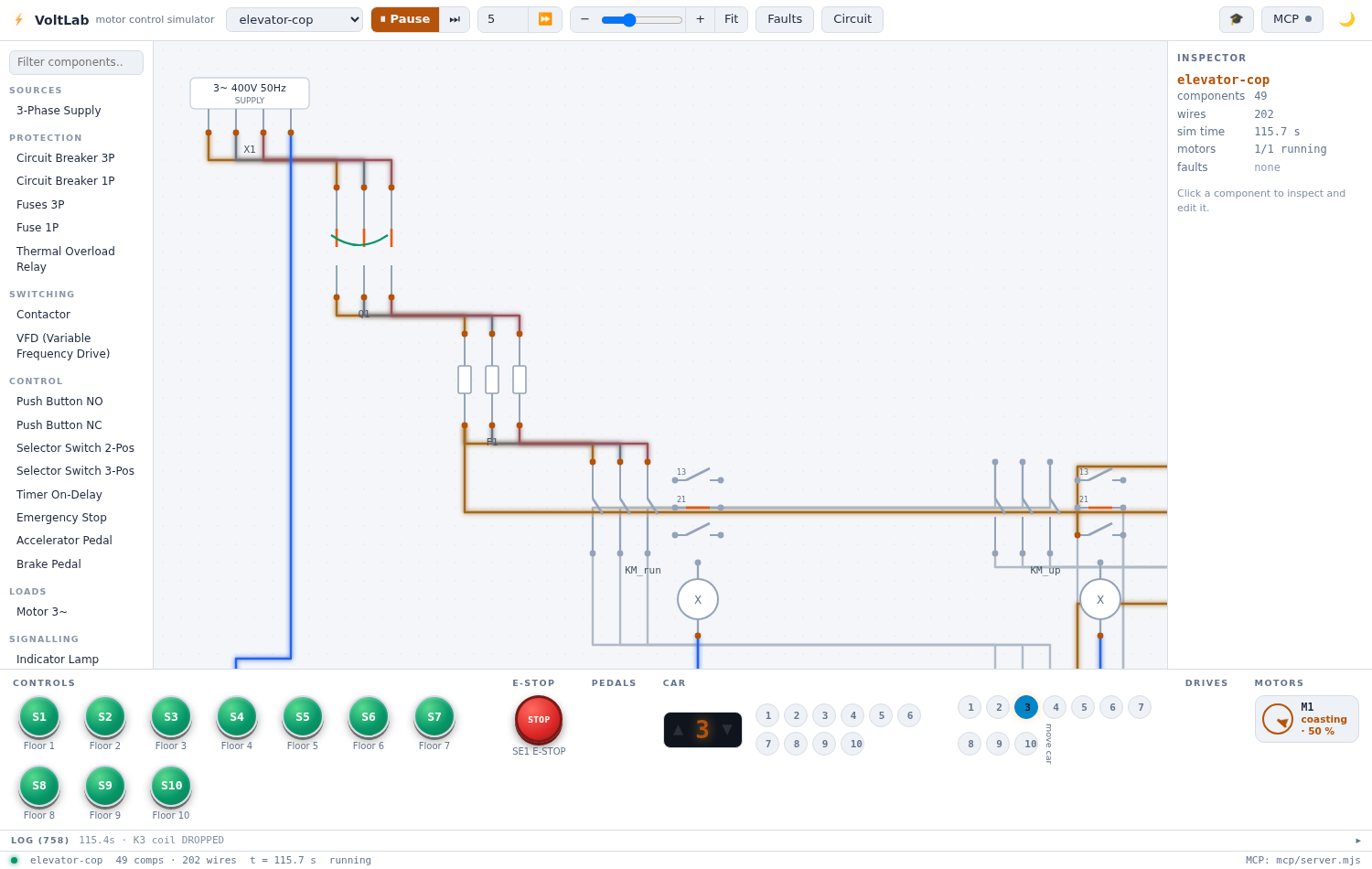
Elevator with car operating panel: car-call buttons, 7-segment floor indicator and travel arrows
elevator-cop: hall buttons and car calls share one relay bank; the cam's isolated indicator deck drives the floor display without backfeeding the control decks.
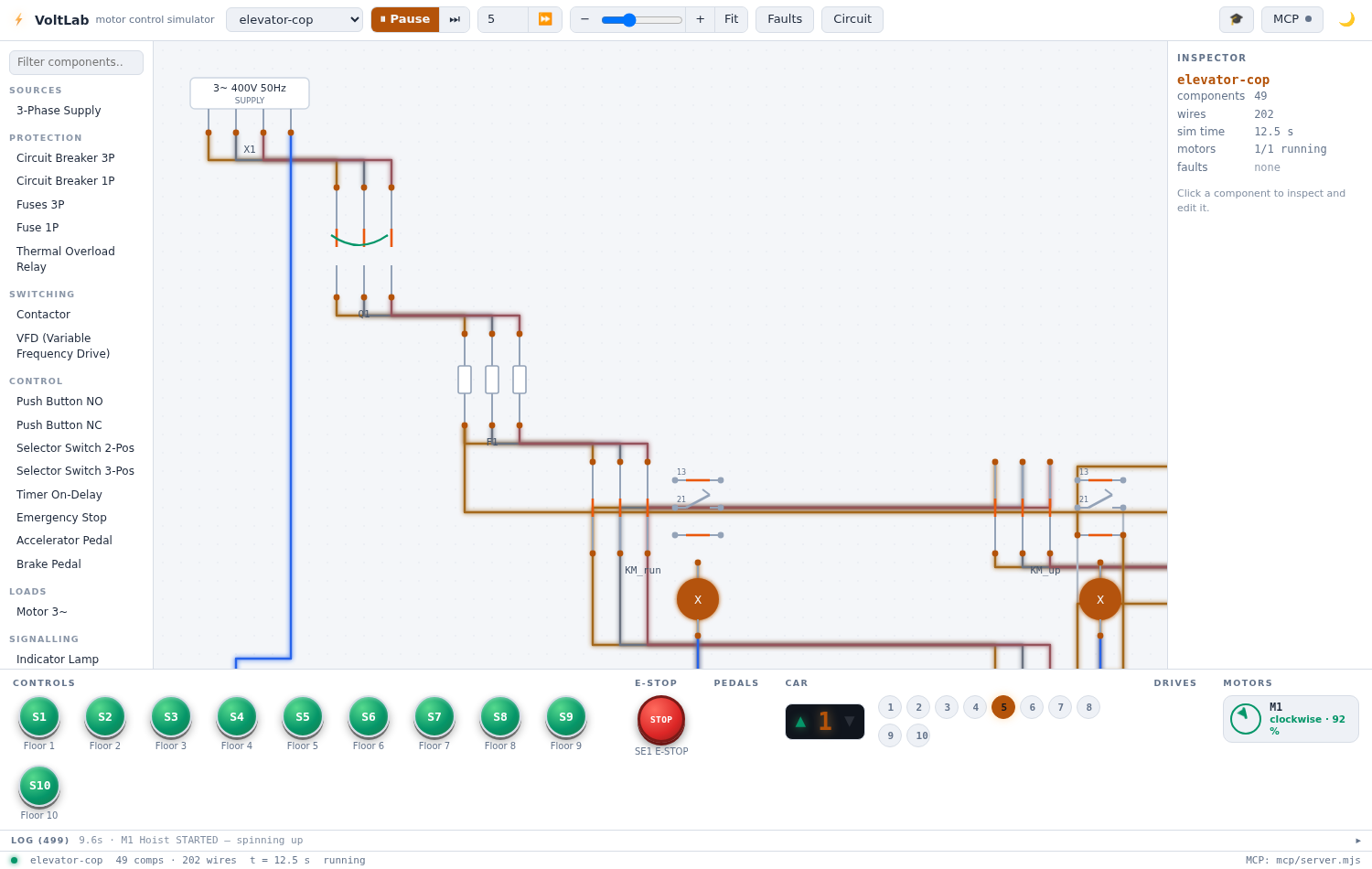
Elevator mid-journey: floor indicator showing 5, hoist motor running
Mid-travel: the 7-segment indicator and up/down arrows track the hoist motor's direction — just like the landing fixtures.
Examples included

Seven worked circuits, all test-covered

CircuitWhat it demonstrates
dol-starterDirect-On-Line start/stop, seal-in holding, class-10 overload trip, trip lamp
reversing-starterForward/reverse contactors, phase-swap wiring, an interlock that makes simultaneous energizing impossible
timer-sequenceOn-delay timer starts a second conveyor motor 3 s after the first
elevator-2floorCall latching, travel limit switches, NC cross-interlock, hoist overload
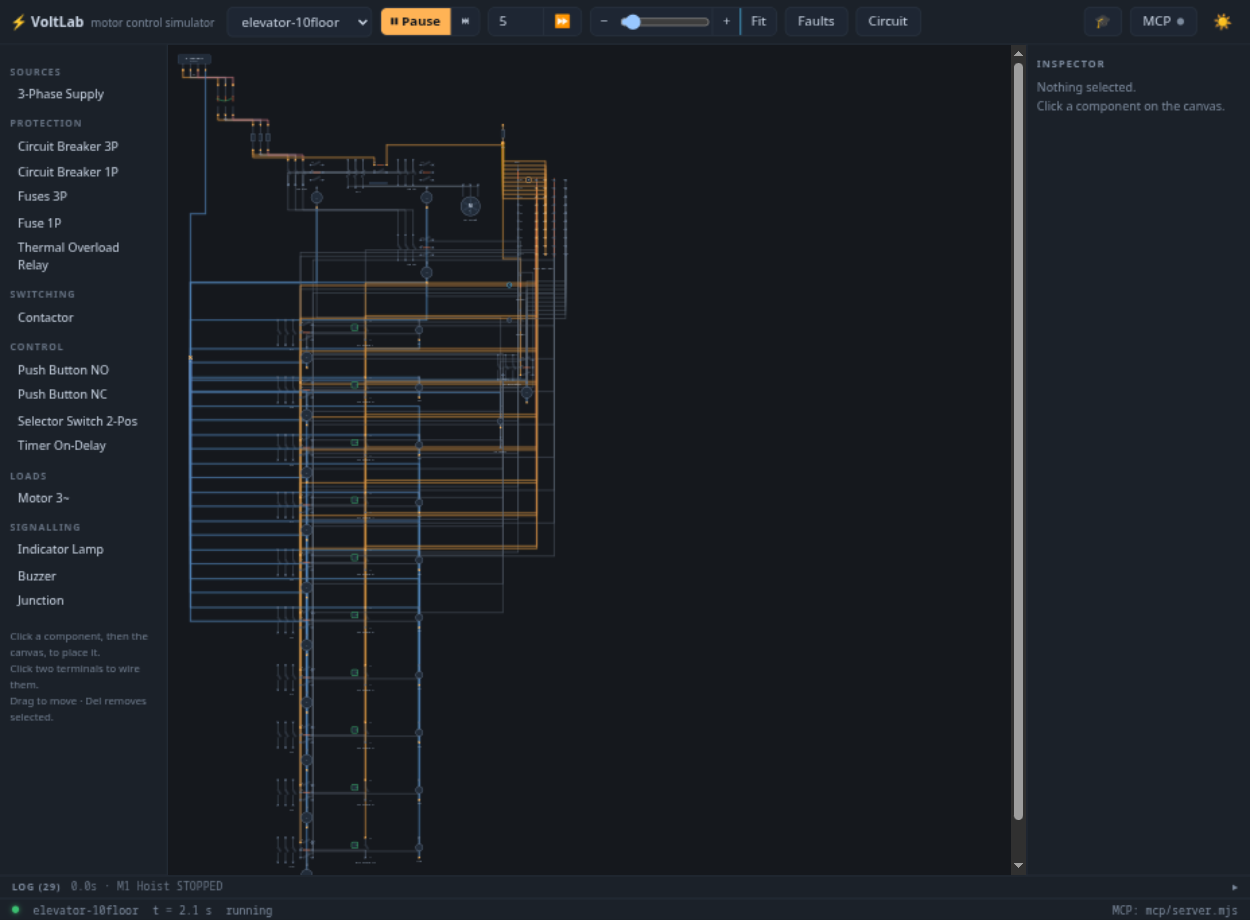
elevator-10floorFull 10-story relay elevator — 4-deck floor cam, per-floor call relays, auto-dispatch with dwell: 46 components, 174 wires
vehicle-driveElectric vehicle drive — VFD with synthesized rotating field, accelerator pedal as the analog speed reference, service brake with NC drive interlock + mechanical deceleration + lamps, key switch, FWD/OFF/REV selector, e-stop
elevator-copThe 10-story machine plus a car operating panel — car calls parallel the hall buttons, the cam's isolated indicator deck feeds the floor display, e-stop in the control feed: 49 components, 202 wires
The 10-story relay elevator circuit overview
The 10-story relay elevator — every K1–K10 call relay, contactor and cam deck is live.
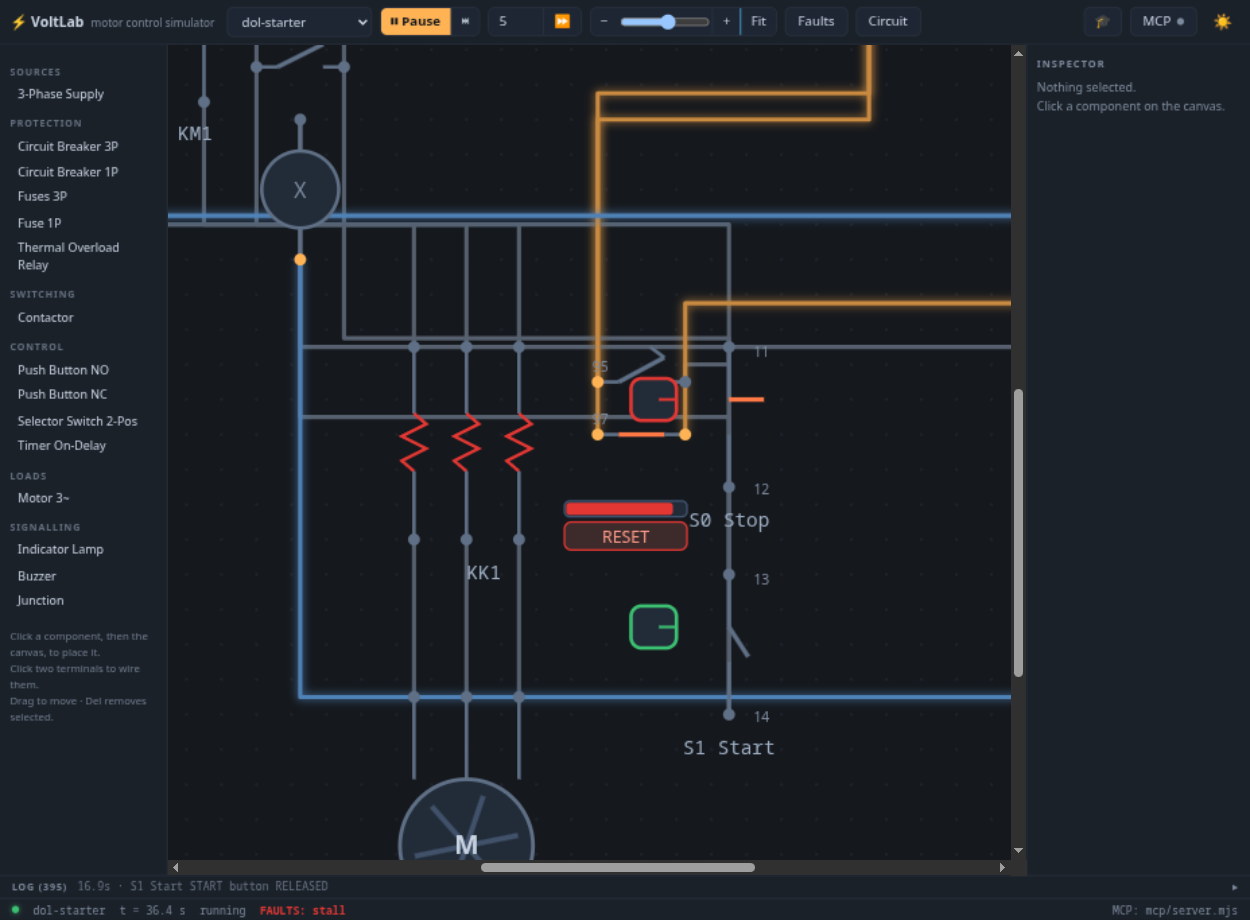
Tripped thermal overload close-up
After ~15 s of locked rotor the class-10 overload trips: coil dropped, trip lamp lit, red RESET waiting.
Documentation that writes itself

Exports a real drawing set

One click (or one agent tool call) turns any circuit into an IEC 61082-1-style PDF drawing package — and records a narrated-by-captions demo video.

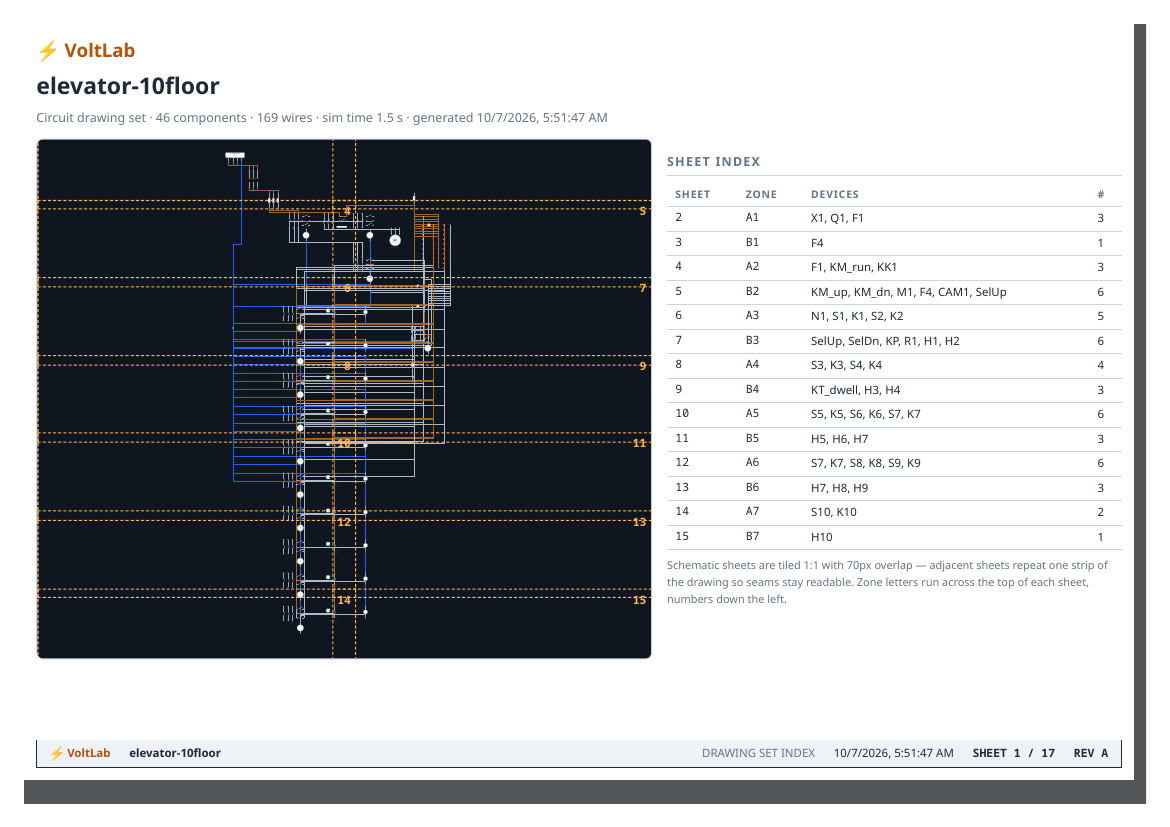
PDF drawing set index sheet with tile map
Sheet 1: cover with full-circuit overview, numbered tile map and sheet index.
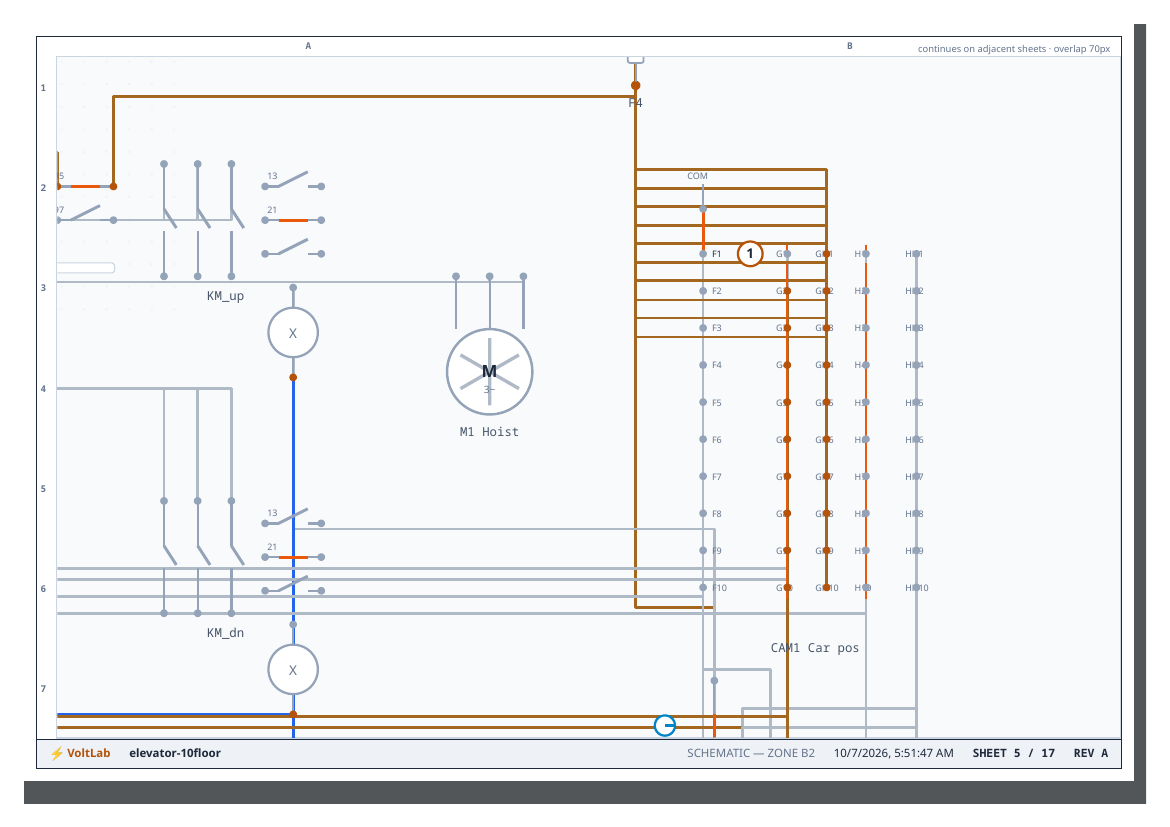
PDF schematic sheet with zone grid and title block
Schematic sheets: 1:1 tiling across A4 landscape, zone grids, title blocks — the elevator spans 17 sheets.
v1.3.1 — cross-platform

Take it with you

Every release ships signed desktop installers plus an Android APK that packs the full offline editor — place, wire, edit and run circuits with no server, no network, no backend. Same engine, same circuits, same UI as the page above.

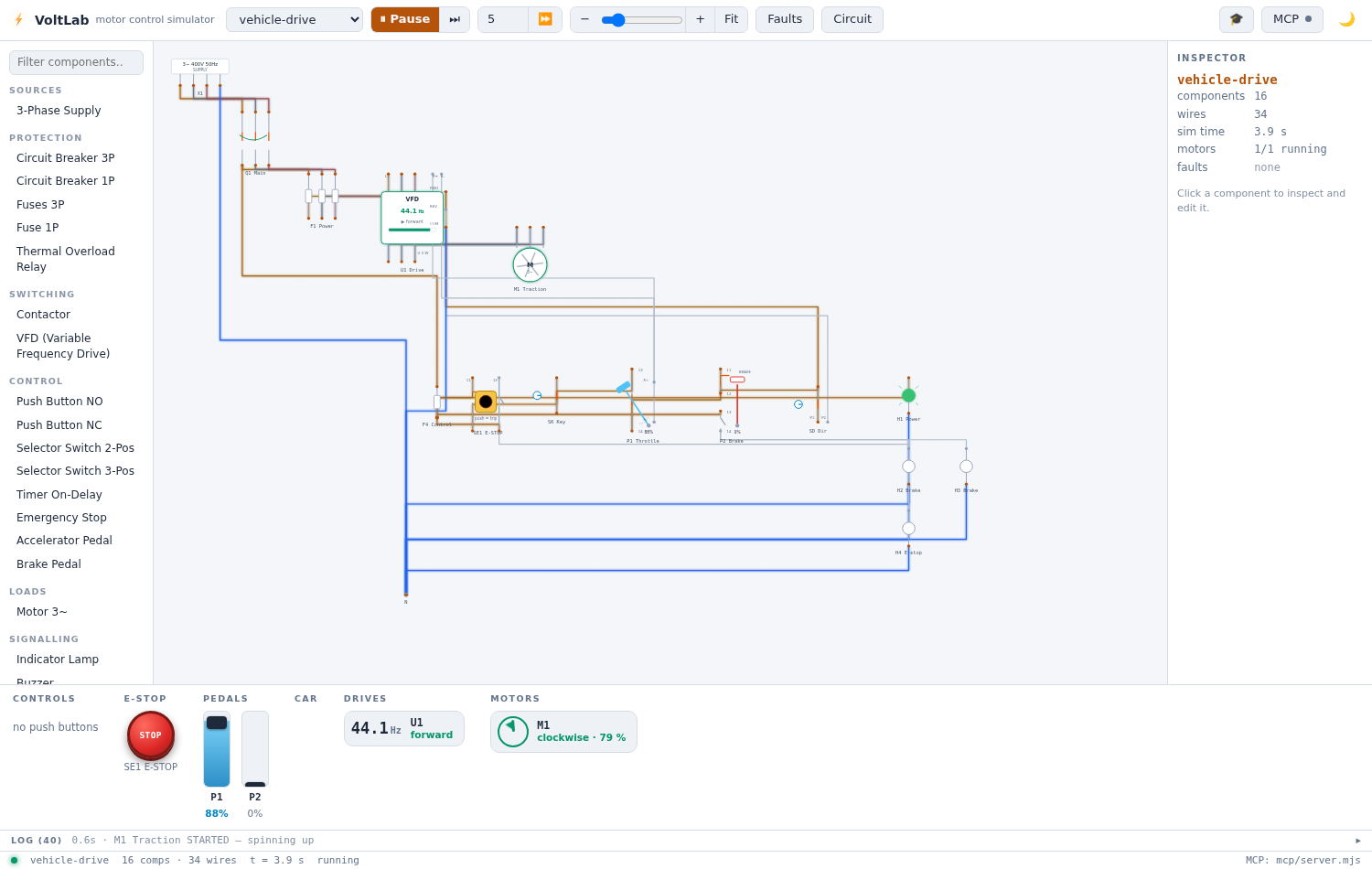
VoltLab offline editor running from the APK bundle, ramping a VFD drive at 88 percent pedal
The offline editor — here ramping the drive to 44 Hz at 88 % pedal. Circuits save to local storage; the whole bundle is ~380 KB.
⬇ Desktop installers — GitHub Releases 🤖 Android APK — 3.4 MB, full editor

Windows setup + portable, macOS dmg for Apple silicon & Intel, Linux AppImage + deb. The APK upgrades in place over earlier VoltLab installs (same signing key), and SHA-256 sums are published with every release.

Run the full app

Quick start

git clone https://github.com/touhidsiddiqueeraj-bit/VoltLab.git
cd voltlab
npm install            # once — installs Electron only

npm run serve          # browser mode → http://127.0.0.1:8123
npm start              # or the Electron desktop window
npm test               # 57 headless tests: engine + circuits + features + MCP end-to-end

Agents connect over MCP — point any client at mcp/server.mjs and it gets the full 29-tool catalog (reference).

Go deeper

Documentation